
Start a Lomita Residents Directory Search
Lomita is an incorporated city inside Los Angeles County, so the right starting office depends on the question. The City Clerk holds municipal files, permits, planning material, council records, and public-record request routes. The county keeps property, tax, recorded-document, court, and vital-record systems. California offices add voter-status, license, business, unclaimed-property, and archival paths. A name, street address, or historical year points to a different first source.
A residents directory is best treated as a dated evidence trail. The assessor can connect a street address to a parcel and assessment record. A recorder entry identifies parties to an instrument. A directory volume may show a telephone subscriber or a person listed at a house. A voter status result authenticates one person, while court, vital, license, and probate records answer narrower questions. None of those roles alone proves every person who lived at an address.
- Define the role you need. Write down whether the goal is an owner, a listed subscriber, a registered voter match, a court party, a family-history lead, or a municipal project contact.
- Start with the Los Angeles County Assessor Portal when an address is known. Use its address or parcel modes to obtain the parcel key and map context.
- Use Lomita's Street & Parcel Map and cross streets when a unit, corner, commercial site, or new development does not resolve cleanly in the assessor search.
- Carry a specific parcel and likely owner name to the Los Angeles County Registrar-Recorder/County Clerk. Its real-estate index is organized by grantor or grantee name and recording year, not by street address.
- Run My Voter Status only as an authenticated personal check, or use the statutory voter-file request route when an approved election, scholarly, journalistic, political, or governmental purpose applies.
- Use the Los Angeles Superior Court party index, vital-record custodian, Secretary of State business search, Department of Consumer Affairs license search, or State Controller unclaimed-property search for the narrower record question.
- When no portal supplies the needed field, ask the custodian for an identifiable record, contact the library or archives, or file a focused California Public Records Act request. Save the source, date, and geographic scope with every result.
Where Lomita Resident Records Are Kept
Los Angeles County is the decisive records geography for Lomita. The Registrar-Recorder/County Clerk keeps recorded property instruments and county vital records. The Assessor keeps parcel and assessment information. California's Secretary of State provides the individual voter-status service and controls the voter-file request process. Lomita's own Clerk and Building & Safety divisions add the municipal layer for permits, planning actions, council material, and city-held project files.
Los Angeles County RR/CC
Real Estate Records
Norwalk, California
800-201-8999
Recorded-document requests
Los Angeles County Assessor
Assessor Portal
Specific parcel requests
Portal, phone, or counter
Address and AIN search
California Secretary of State
My Voter Status
Authenticated individual match
Purpose limits apply
Voter-status lookup
The Lomita City Clerk accepts a focused request by email, mail, or hand delivery. Electronic copies are free; paper copies cost $0.10 per page and are billed in advance. The office lists 24300 Narbonne Avenue, Lomita, California, 310-325-7110, and Monday through Thursday hours of 7:30 a.m. to 5:30 p.m., plus every other Friday from 8 a.m. to 5 p.m. The Building & Safety Division handles plans, permits, inspections, and transferred county files through GeoCivix, with a counter, email, and phone route.
Use the custodian that owns the record rather than asking one office to build a new resident list. The county recorder, assessor, court, elections, and vital-record systems do not share one index. City files can fill a project or address gap, while the library and archives are the practical route for older directories, newspapers, and census material.
Convert a Lomita Address into an AIN
The Los Angeles County Assessor Portal is the cleanest first move when a Lomita search begins with a street address. It ties the situs address to a ten-digit Assessor Identification Number, parcel characteristics, legal-description clues, assessment information, transfer clues, and a map. The portal is free to use, but its public pages do not advertise a general owner-name search. That makes the address the bridge into the rest of the record trail.
The Assessor Portal capture in the Lomita source inventory shows the address and parcel entry point. Use the map when a house number is hard to match or when adjacent parcels matter.
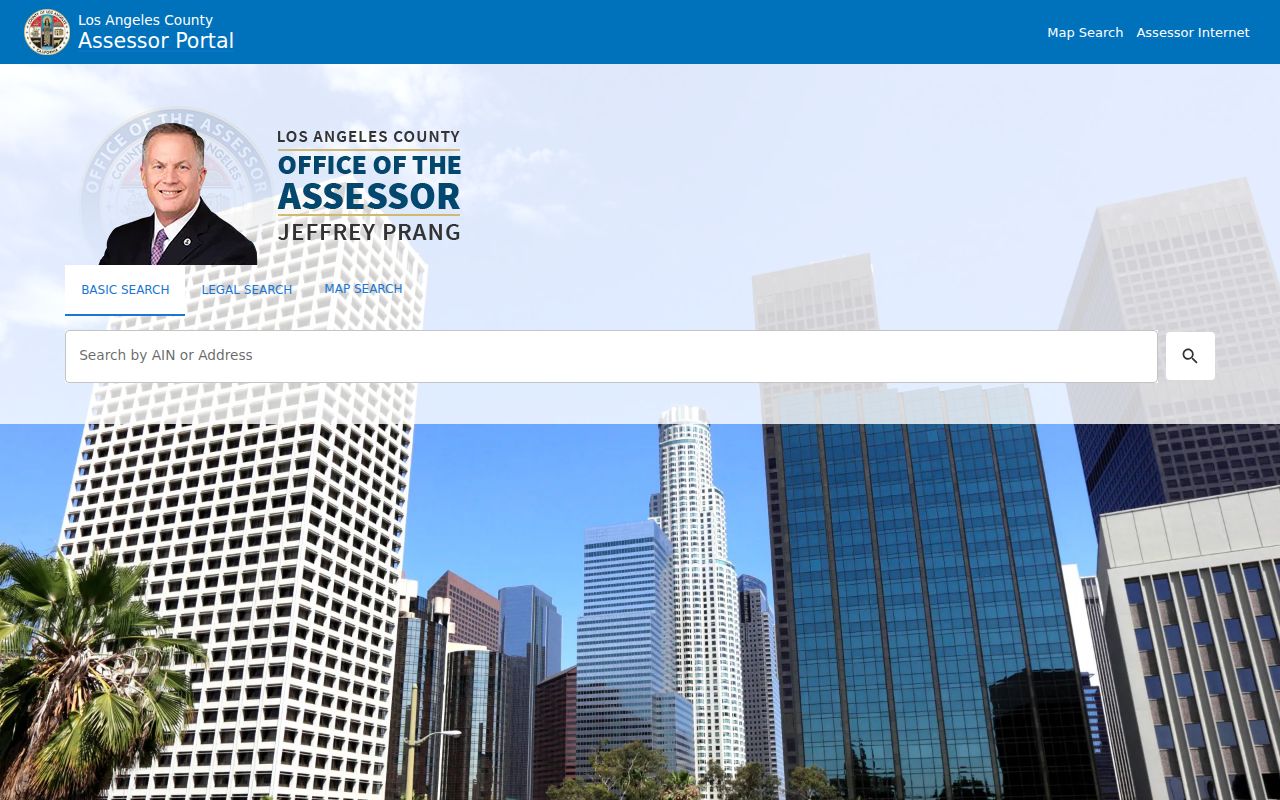
The result is parcel evidence, not a complete household list. Owner information can be supplied for a specific parcel through the Assessor by phone, counter, or contact form, while bulk data is a separate Property Data Sales product. A failed search is common with multi-unit, commercial, corner, or new-development addresses. Cross streets and the map can help locate the correct AIN without guessing at a unit or lot.
| Portal mode | Control | Use in a Lomita search |
|---|---|---|
| Basic Search | Tab | Primary entry into the public property search. |
| Search by AIN or Address | Autocomplete text | Accepts a ten-digit AIN or a situs address. |
| Legal Search | Tab | Uses the legal-description path; dynamic subfields were not fully captured. |
| Map Search | Tab or link | Browses mapped parcels and helps resolve cross-street questions. |
Keep the AIN, legal description, effective date, and map context with the result. Those details let a later specific-owner request and recorder search refer to the same land even when a postal line, unit label, or street spelling changes.
Why Lomita Deeds Need a Name Search
Los Angeles County real-estate records have a useful limitation: the RR/CC does not maintain the deed index by street address or APN. There is no public Internet deed-search portal. The in-office index uses a grantor or grantee name with a recording year. The RR/CC request page cites a 1850 starting point, while the local coverage table treats 1851 onward as the verified archive run.
The recorded-document request capture shows the official route for copies and the county's long coverage. It belongs after the assessor step, because the recorder's index needs a person name and year rather than a modern street key.
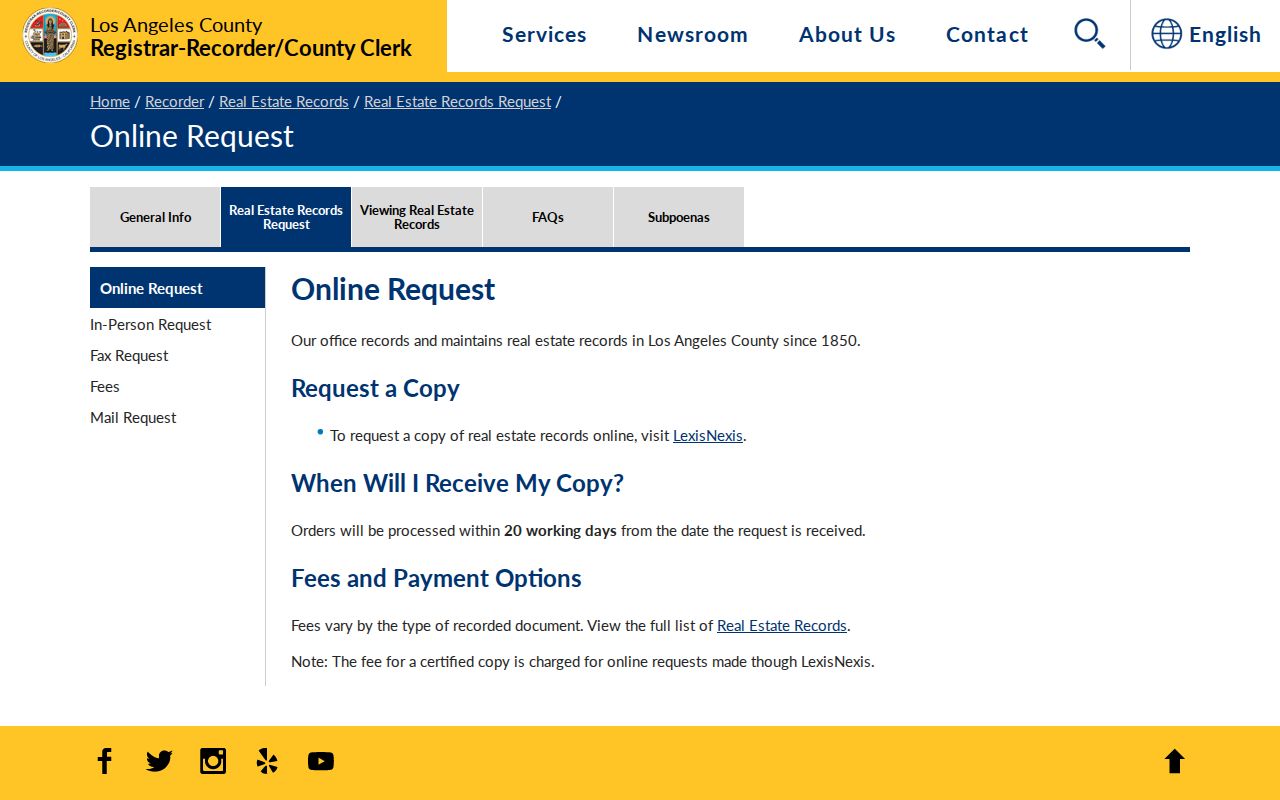
For an in-person search, Room 2207 in Norwalk holds the annual index. The 1851 to 1957 material is on the lower level, while 1958 to the present is on the second floor. Telephone index searches are not accepted. Copies can be requested through the RR/CC-linked LexisNexis route, by mail to the Real Estate Records Section in Norwalk, or at the counter. Online orders are processed within 20 working days, and full documents rather than selected pages are purchased. A plain copy is listed as $5 for the first page plus $3 for each additional page; a certified copy is $6 plus $3 for each additional page. A card or mobile-wallet service charge is $1.75.
Search the current owner as a grantee in the likely acquisition year. Read the deed for the grantor, recording reference, and legal description. Then search that grantor as a grantee in an earlier year. The chain works backward through names and legal descriptions, not by typing the street into the recorder system. The county's viewing instructions explain the in-office route.
Note: A recorded party is evidence of an instrument, not proof that the named person lived at the parcel.
Current Lomita Resident Directory Sources
No single current roll can answer who lives throughout Lomita. Each source has a keeper, a date, and a role attached to the name. The assessor starts from land. My Voter Status authenticates one voter. The recorder names parties to recorded instruments. City files show projects and permits. Business, license, and unclaimed-property indexes create leads that need a second record before they are treated as evidence of a person at a Lomita address.
| Source | Role shown | Official keeper | Access path |
|---|---|---|---|
| Assessor parcel and assessment | Owner clues, situs, legal description, values, characteristics, map | Los Angeles County Assessor | Free address or AIN search; specific-owner contact route |
| My Voter Status | One person's registration status, party, vote-by-mail, polling, and districts | California Secretary of State | Free authenticated match; voter-file use is restricted |
| RR/CC recorded index | Parties, instrument type, recording date, and document reference | Los Angeles County RR/CC | Norwalk name-and-year index; copy request by online, mail, or counter route |
| Lomita city files | Permits, inspections, planning actions, council material, applicants | City Clerk and Building & Safety | Web archives, GeoCivix, email, mail, hand delivery, or counter request |
| Business, license, and property claims | Agents, licensees, entities, and reported holders | California SOS, DCA, and State Controller | Official name searches; confirm the role and date |
The USPS ZIP Code Lookup can verify the delivery line attached to a Lomita address before a postal clue is compared with a city boundary or parcel record.
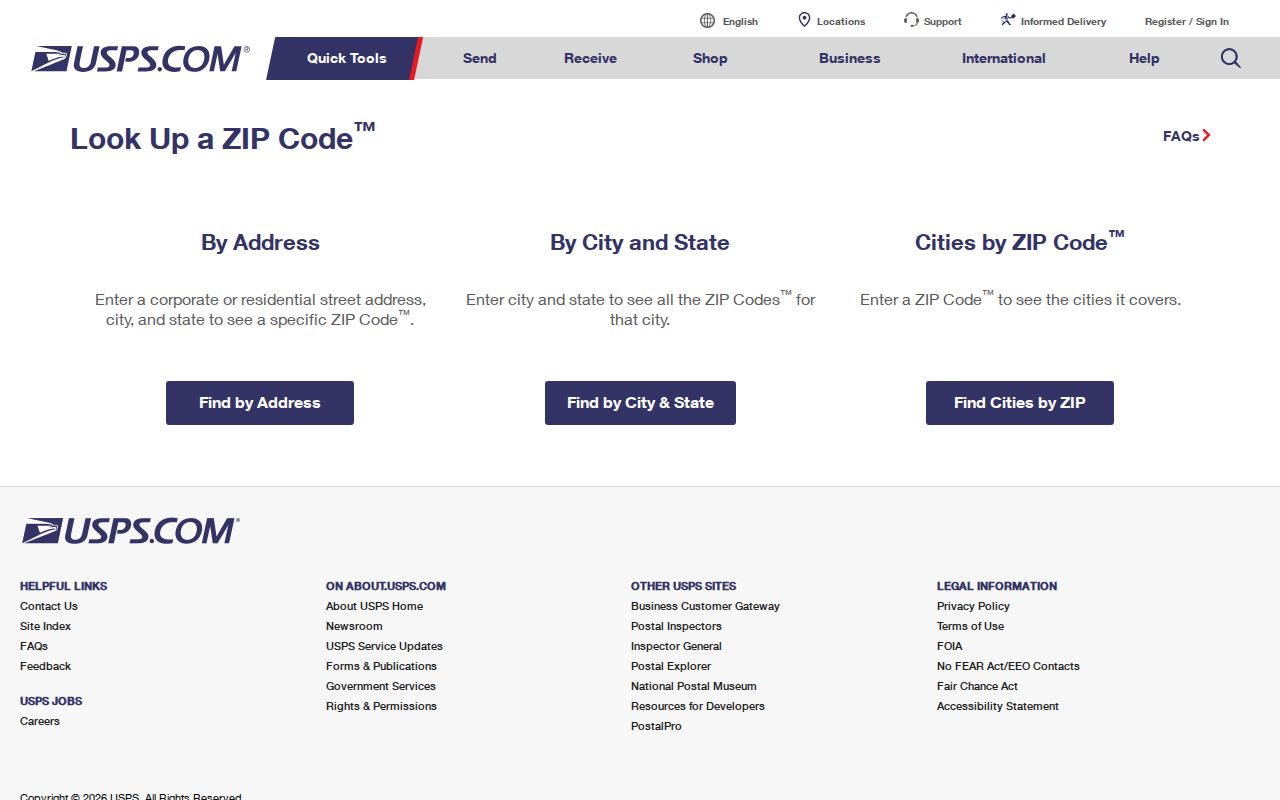
The USPS result answers a mail-routing question. It does not create a ZIP-wide resident list or replace the assessor, recorder, court, or city custodian.
The table separates access from meaning. A current assessor owner may be an absentee owner. A tax-mailing address may not be the situs. A directory subscriber may have moved, and a business agent may not be a resident. A court party is tied to a case, not a finding of wrongdoing. A strong Lomita residents directory search keeps these labels intact and compares dates rather than merging them into one undated household claim.
What California Voter Status Can Confirm
California's My Voter Status service is a personal match, not a public street-by-street list. It can show registration status, party preference, vote-by-mail status, polling place or vote-center information, districts, and ballot or election information. It never shows how someone voted. The form uses first name, last name, date of birth, and, where needed, a California driver license or ID number or the last four digits of a Social Security number.
The California voter-status capture in the Lomita source inventory makes the authentication boundary visible.
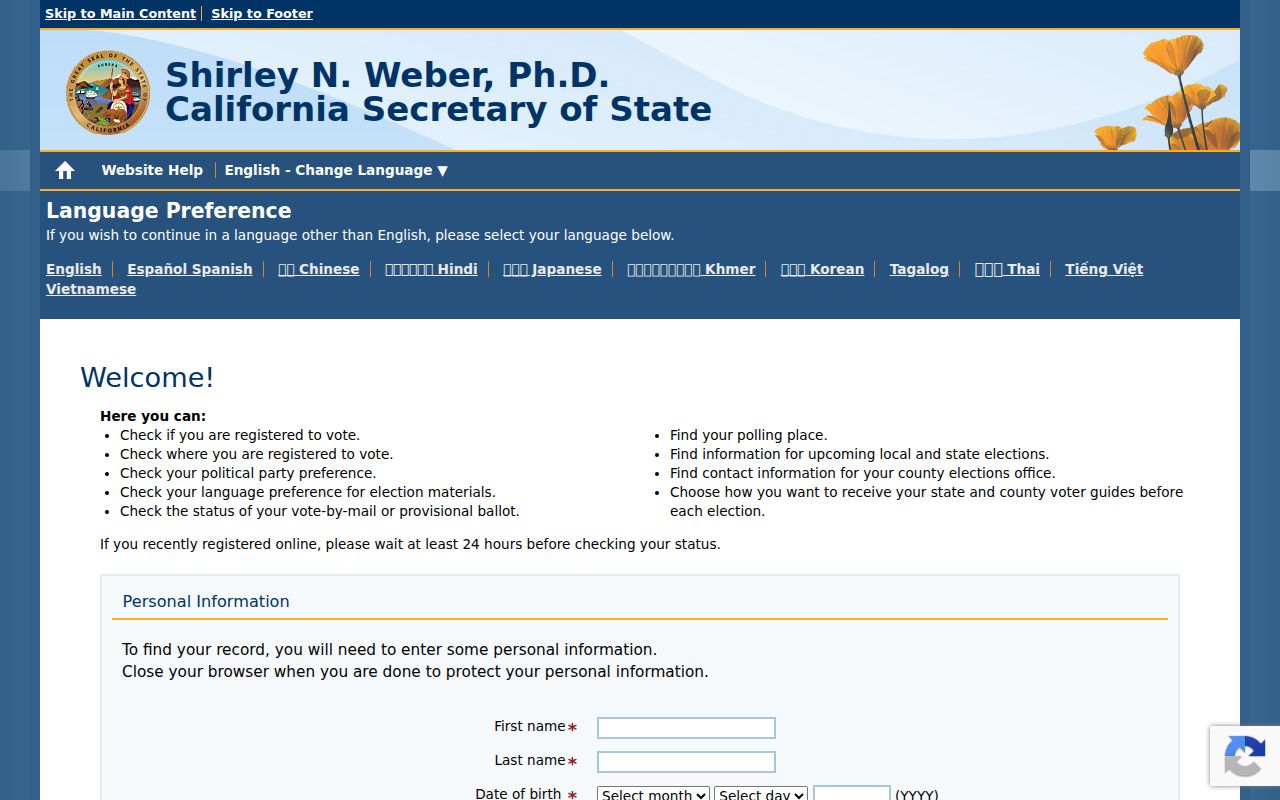
Voter-registration information is purpose-restricted under Elections Code §2194. Election, scholarly, journalistic, political, and governmental purposes are the listed lanes for registration-file use. Government Code §7924.000 protects home address, telephone, email, precinct, and prior registration except for authorized release, while driver-license, Social Security, unique-identifier, and signature fields remain confidential. Elections Code §18109 makes specified unauthorized use a misdemeanor and allows a fine up to $50,000. A Safe at Home participant may use a substitute address and confidential voter registration.
For an approved file request, the Secretary of State asks for requester and organization details, geographic scope, the data sought, intended purpose, responsible person, delivery information, and a certification under penalty of perjury. County subsets may be requested through the RR/CC in Norwalk. That process is different from the free individual status check, and neither should be presented as a public Lomita resident roll.
Note: My Voter Status authenticates one person; it does not disclose every registered voter who may be associated with a Lomita street.
Match Lomita Names to Official Records
A name search becomes more reliable when the record type matches the question. The Los Angeles Superior Court case gateway offers free case-number and calendar paths. The party-name index covers Unlimited Civil, Probate, and Family matters from 1983 forward, Limited Civil from 1991 forward, and Small Claims from 1992 forward. Party-name searches are paid, and payment is due before results even when there is no match. Guest searches are listed at $4.75, while registered accounts use a sliding fee schedule.
Returned party-index fields include litigant names, case type, filing date, filing location, and the number of available imaged documents. Case-number summaries are free. Civil images cost $1 per page for pages 1 through 5, then $0.40 per page up to $40 per document; criminal and family-law images are not online. Sealed matters, paternity and minor-related matters, and specified family details are excluded. Public terminals, the court clerk, and the holding division remain fallback channels for public files that are not imaged.
Vital records answer event questions, not present-address questions. Los Angeles County RR/CC and the California Department of Public Health issue birth, death, and marriage records through dedicated ordering channels. California distinguishes informational copies from authorized identity copies. Birth and death copies require the eligible relationship and, when required, a notarized sworn statement. County routes may be faster for a Lomita event. Divorce files are Superior Court records; CDPH can supply a certificate of record for specified years, not the full decree.
- Birth record
- CDPH or county custodian; informational copy broadly available, authorized copy limited by Health & Safety Code §§103526 and 103526.5; 2026 state fee listed as $31.
- Death record
- CDPH or county custodian; informational and authorized routes differ; 2026 state fee listed as $26.
- Public marriage
- RR/CC or CDPH route using both parties and the event date; 2026 state fee listed as $19.
- Dissolution certificate
- CDPH certificate of record is not the Superior Court decree or full case file; 2026 state fee listed as $18.
Applications use VS 111 for birth, VS 112 for death, VS 113A for marriage, VS 113B for dissolution, and VS 20 when an authorized-copy sworn statement is required. Mail orders use a U.S.-bank check or money order payable to CDPH Vital Records. The fee is retained as a search fee when no record is found, and wrong or missing payment can return the order.
Official Lomita Rolls and Compiled Data
Official records and commercial compiled people-search services answer different questions. A government index has a custodian, a stated scope, and a record date. A compiled service may merge public and private data, lag a transfer, or connect two people because names and addresses look alike. The compiled category can suggest a lead, but an official office is the place to verify it. Personal family history, reconnecting, property curiosity, and civic research are better served by preserving the source trail.
| Source type | Strength | Limit to keep visible |
|---|---|---|
| Assessor parcel record | Connects address, parcel, map, characteristics, and assessment clues | Owner access is parcel-specific; ownership is not proof of occupancy |
| Recorder index and deed | Shows indexed parties, instrument, date, and legal description | Los Angeles County uses name and year; it is not address or APN indexed |
| City file or court index | Shows a project, case, filing date, party, or agency action | A case or applicant role does not establish a household relationship |
| Compiled people-search category | May surface a spelling, former address, or relative as a lead | May be stale, merged, incomplete, or wrong; verify with the custodian |
Keep the words owner, tax-mail recipient, subscriber, registered voter, licensee, business agent, court party, and permit applicant separate. When two sources disagree, record the conflict and the dates. Do not turn a compiled household grouping into a claim about everyone at a Lomita address.
Lomita Business and License Lookups
A resident search sometimes starts with a business name or professional role. California's business index can return entity number, status, jurisdiction, formation date, address, agent, officer, and filing links as available. The professional license index covers board, license type or number, business, first or last name, city, and county modes. Results can show license type, status, board details, and discipline links.
Los Angeles County fictitious business-name records and Lomita's city Finance or custodian route add local business evidence. A business address may be a storefront, mailing address, agent address, or public professional address. The label matters. An entity officer is not automatically an owner of a parcel, and a licensee is not automatically a resident. Save the entity number, license number, status date, and public address before comparing it with another record.
The State Controller's unclaimed-property search is another narrow lead. Search by last or business name, then narrow by first name, city, or ZIP. A result identifies a holder and reported property connection, not a current home. Claims are free through the official Controller route and require proof. Unsolicited callers who demand a fee or rush a claim should be checked against the official listing before any information is shared.
Note: A license, agent address, or unclaimed-property listing identifies a public role or reported connection, not present residence.
Lomita Historical Resident Directory Shelves
The historical Lomita residents directory is regional rather than city-labeled. The LA County Library Californiana Collection at Norwalk holds the relevant South Bay and Los Angeles runs in closed stacks at 12350 Imperial Highway. Its collection includes more than 24,000 books, over 200 magazine and newspaper titles, California census schedules from 1850 through 1910, the Los Angeles Star from 1851 through 1879, nineteenth-century city directories, and official histories. Call or use reference service before traveling. The exact run matters because gaps in the inventory are real.
The Californiana Collection and its directory inventory identify these Lomita-relevant volumes:
- Los Angeles, Greater Business Directory, listed for 1952.
- Los Angeles South Suburban Cross-Cross Directory by Haines, listed for 1981, 1983 through 1986, and 1988.
- Los Angeles County South Coast Cross-Cross Directory by Haines, listed for 1989, 1990, and 1992.
- South Bay Address and Phone Directory by Pacific Bell, listed for June 1988 and December 1990, 1991, and 1992.
- South Bay YP/WP editions listed for 2001-02, 2003, 2004-05, 2005, 2006, 2008, and 2009.
A cross-cross volume reverses the normal name-first order. Browse the street, house number, and listed subscriber or occupant, then compare the next available edition. A directory listing is not a deed, and the named person may be a subscriber, business, or occupant. The full collections, entry-reading method, and year-by-year cautions belong with the Lomita city directory collections.
Search Lomita Before Incorporation
Older Lomita research begins with land history rather than a modern house number. Before city government, the evidence follows Rancho San Pedro, Rancho Los Palos Verdes, Los Angeles County, subdivision maps, deeds, newspapers, and church or school traces. A boundary dispute was resolved in 1841. Rancho Los Palos Verdes was subdivided and sold to 17 buyers in 1882. In 1907, W. I. Hollingsworth bought and subdivided a seven-square-mile colony, setting up the tract, lot, post-office, school, and church references that later directories use.
The 1923 oil discovery changed land values and land use. Reported lot values moved from $300 or $400 to as much as $35,000, and about 500 acres shifted to oil use. Deeds, mineral interests, leases, newspapers, and occupations such as grower, truck farmer, well worker, driller, or company employee can help separate people with the same name. Lomita incorporated on June 30, 1964, so municipal clerk, planning, and code series mainly begin after that point. County property records reach back to the earlier land eras.
For the rancho, subdivision, and early municipal layers, the California State Archives and the library's local-history references are better starting points than a current resident directory. Preserve the historical locality, then test the parcel against the modern Lomita boundary. The original community was larger than the current incorporated footprint, and an old directory entry can carry a place name that no longer matches today's city line.
Lomita Library's Records Story
The Lomita Library itself is part of the records trail. It opened in June 1914 in a clubhouse with 232 books and 14 cardholders. It moved to the Smith Building storefront in 1918, a new building in 1928, the former Pioneer Press building in 1960, and the civic-center site dedicated on April 10, 1976. Those changes help explain why local newspapers, photographs, and directory references may be split across branch, regional, and historical-society holdings.
The Lomita branch provides telephone and in-person research help, photocopying, catalog and database access, Los Angeles Times coverage through ProQuest, and Daily Breeze coverage through NewsBank. The Lomita Historical Society, founded in 1974, keeps more than a century of area information and can be reached at its local research contact. Its 2019 Photo History Project scanned resident-held pre-1980 photographs and documents about people, places, events, and daily life, while contributors kept the originals.
Ask for a precise street, surname, approximate year, and event. Staff can help decide whether a closed-stack Californiana volume, newspaper database, society file, or archive finding aid fits the question. A caption or donor note can bridge a directory gap, but it is still a lead. Confirm names and relationships with a dated deed, vital record, probate file, or other independent source.
Note: A library reference can locate a source, but the volume, page, date, and custodian still control what a name actually proves.
File a Focused Lomita Records Request
Lomita's City Clerk asks for a specific existing record rather than a request for “all files relating to” a topic. Useful retrieval clues are a document title or number, street address or property location, developer name, and the date of a Council or Planning Commission action. The city request form includes requester and contact fields, a description box, and choices for review, copies, or another action.
Submit by email, mail, or hand delivery through the City Clerk's public-records route. Electronic copies are free. Paper duplication is $0.10 per page, billed in advance. The form retains an older citation, but the current California Public Records Act is Government Code §§7920.000 through 7931.000, with a determination ordinarily due within 10 calendar days under §7922.535. An agency can take a written extension of up to 14 days in unusual circumstances. That deadline is for deciding whether responsive records will be disclosed, not a promise that final production will be complete by day ten.
The CPRA does not require an agency to create a new resident list, answer an open-ended research question, or override a confidentiality law. Ask for an identifiable permit file, agenda packet, resolution, map, inspection record, or correspondence set. If the city does not hold it, the request should point toward the county, court, state, library, or archive that does.
Note: A focused request gives the custodian a record key and date, which is more useful than asking an office to assemble an unnamed household list.
Privacy Choices for Lomita Records
California's privacy tools sit beside, not inside, the government-record workflow. The CCPA gives covered consumers rights to know, delete, correct, opt out of sale or sharing, limit sensitive-information use, and receive equal treatment. The DELETE Act's DROP platform opened one broker-deletion request on January 1, 2026. Registered brokers began retrieving and processing requests on August 1, 2026, then at least every 45 days subject to exceptions.
DROP applies to registered commercial data brokers. It does not erase a deed, assessor roll, court index, voter record, vital record, or other government record. A person can use a provider's privacy or do-not-sell route, submit only the matching data needed, complete verification, save the confirmation, and recheck later. Government Code §§27300 through 27307 provide recorded-document Social Security number truncation and restricted unredacted-access processes.
Safe at Home serves qualifying participants through a substitute address, mail forwarding, confidential voter registration, and limited deed or address protections under Government Code §§6205 through 6211. It does not retroactively erase every public record. Public systems can also withhold sensitive fields under their own statutes. A missing address is not proof that a person has no local connection.
Use the Lomita Residents Directory Lawfully
Public availability has boundaries. California Penal Code §646.9 addresses stalking. Code of Civil Procedure §527.6 provides a civil-harassment restraining-order path. Penal Code §530.5 covers willful unlawful use of another person's identifying information. The Driver's Privacy Protection Act restricts motor-vehicle data, and Elections Code §18109 limits certain voter-data uses. These rules matter when a record search moves from family history or civic research toward contact with a real person.
Keep a narrow purpose, use the official custodian, and avoid publishing private details. Do not turn an owner name, phone subscriber, court party, licensee, or voter match into a public list. Preserve the source date and let a person or office correct a record through the proper channel.
Lawful personal use. Lomita records are useful for family history, reconnecting, property research, and civic transparency. Never use a residents directory or public-record trail to stalk, harass, intimidate, or harm anyone.
Seven Checks for a Lomita Resident Match
A common name needs a repeatable test. The strongest Lomita identification uses two independent official sources whose dates and geography overlap. The source role stays attached to the name from the first note to the final conclusion.
- Normalize the full name, former surname, middle initial, spacing, and spelling variants.
- Anchor the name to a dated Lomita parcel, filing, license, directory, court entry, or event.
- Label the role precisely: owner, tax-mail recipient, subscriber, voter, agent, licensee, applicant, or court party.
- Compare a second official source instead of treating one search result as confirmation.
- Match the event date, address type, jurisdiction, and geographic scope.
- Keep uncertainty visible when a source is missing, sealed, protected, or only a reported lead.
- When records conflict, contact the custodian and preserve both the conflict and the source dates.
That discipline makes a Lomita residents directory useful without turning a partial record into a claim about a whole household. It also points to the next lawful channel when the public portal cannot expose the field.